Joining Judaism, or conversion, is one of the deepest and most meaningful decisions in life.
The conversion process requires serious preparation and study of Torah and halacha (Jewish law).
The peak of this journey, which leads to a successful conversion, is an interview with a rabbi, and then an interview with the rabbinical court (a beit din).
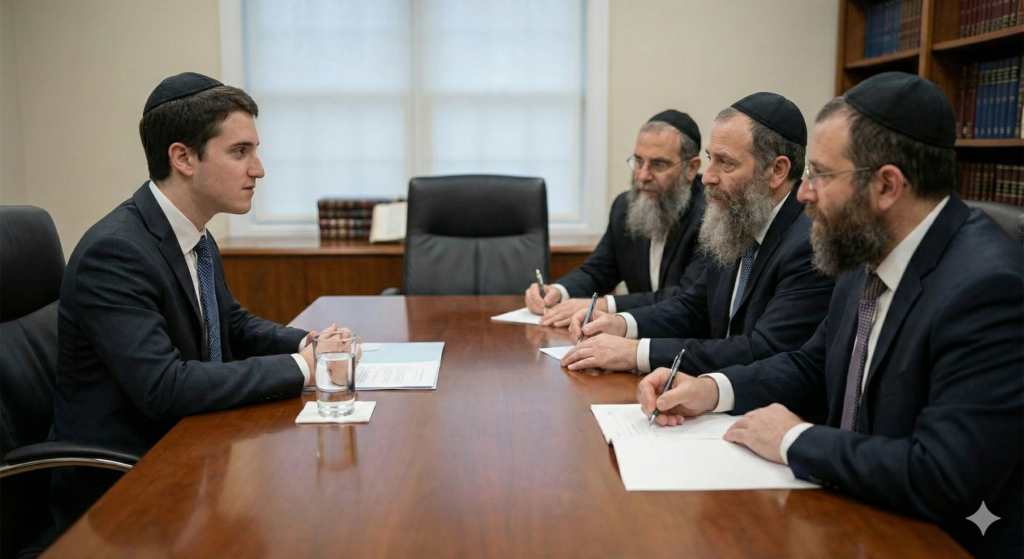
The entire conversion process, from the start of studies to the final mikveh immersion, takes place under the supervision of the Chief Rabbinate.
The rabbi’s role in the conversion process matters a lot.
The rabbi guides you spiritually and supports you at every stage.
This central religious authority enforces full adherence to halacha (Jewish law), which makes conversion not only a formal procedure, but also a deep spiritual experience for the convert.
We understand that this stage can bring strong emotions.
You, as candidates, invest years of study and your soul into the process.
Most often, a conversation focused on your motivations lasts between 30 minutes and one hour.
Our beit midrash, “Keter Shem Tov,” aims to remove uncertainty and make your path easier.
We want you to come to the meeting with confidence.
We want you to understand that this is not a strict test.
It is an honest conversation about your readiness to live a full Jewish life.
Interview at the Rabbinate: A Test of Sincerity, Not a Test of Knowledge
Many conversion candidates worry that a meeting with the rabbi, or an interview at the rabbinical court (beit din), will be a strict exam in Torah or Talmud.
We want to reassure you.
That is not the case.
In practice, the interview is not formal.
Its main goal is to understand your personal story and your true motivations for converting.
In most cases, the conversation lasts between 30 minutes and one hour.
It feels more like a deep talk than an exam.
The rabbi wants to see your readiness to accept the yoke of the commandments, keep halacha (Jewish law), and become a full part of the Jewish people.
Remember that Judaism is not a missionary religion.
The judges of the beit din must be convinced that your decision to convert is conscious and not driven by external circumstances.
You need to speak from the heart.
You need to be ready to discuss how you see your Jewish life in the future.
You need to discuss your participation in the community and in the synagogue.
Our main advice: be yourself.
A successful conversion starts with honesty and a readiness to speak openly about your spiritual search.
To show seriousness, prepare questions for the rabbi about the conversion process, the courses, and practical integration.
This shows interest and readiness for full acceptance of Jewish tradition.
Preparation: The Foundation of Your Path
Success in the interview starts long before you walk into a synagogue or a rabbi’s office.
It starts with your learning and with deep integration into the Jewish community.
The study phase, which is the first step toward conversion, can last from several months up to two years.
The timeline depends on your background and on your readiness to fully absorb Jewish life.
Our beit midrash focuses on more than memorizing facts.
We focus on living according to halacha (Jewish law).
Structured Learning and the Conversion Timeline
Preparation for conversion includes structured study of the fundamentals of Judaism.
You will study kosher laws, Sabbath observance, understanding the holidays, and sacred texts, including the Torah.
We provide structured courses that serve as an “Introduction to Judaism” for you.
Remember that the conversion timeline is personal.
Rabbis and the beit din need to be convinced by your conscious choice, not by how fast you finished the program.
Practical Integration: Readiness for the Commandments
Community integration is a critical step.
Regular synagogue attendance and active participation in local Jewish community life show sincere interest.
The deeper your social and cultural integration, the easier it becomes to complete the entire conversion process.
For a future convert, this is not only about visiting.
It is proof of readiness to keep the commandments in everyday life.
This is exactly what the rabbi will look for in the interview.
Our rabbis emphasize this.
The beit din interview checks not the amount of knowledge, but the sincerity of your heart and your readiness to accept the yoke of the commandments, as Ruth the Moabite did.
7 Steps for a Confident Interview at the Rabbinate
The interview with the rabbi, and later with the beit din, is the peak of your spiritual journey.
It takes the form of a friendly conversation, not a strict exam.
It usually lasts between 30 minutes and one hour.
These steps help you build structured preparation and feel confident at the meeting.
They help you show seriousness and readiness to join Judaism.
Step 1: Sincere Motivation
The rabbi will ask: “Why do you want to convert?”
This is the central question that defines your intention.
Your task is to tell a personal story.
Speak from the heart.
This is not the time to quote textbooks.
Explain how you came to Torah and why you feel the need to join the Jewish people.
The rabbi and the beit din need to be convinced by the depth of your spiritual faith.
Important: If you are converting because of marriage, be honest.
Explain clearly that your decision rests on spiritual faith and readiness to keep the commandments, and not only on a desire to please your spouse.
Step 2: Show Knowledge and Practical Observance
The interview includes a check of your understanding of Jewish life in practice.
Successful preparation includes completing an “Introduction to Judaism” course, which can take from several months up to two years.
Make sure you can speak about how you keep Shabbat, what changed in your home after adopting kosher laws, and how you handle the new requirements of halacha (Jewish law).
You do not need to recite every rule by heart.
You do need to show basic, practical understanding of how you have already integrated Jewish life into your routine.
You do need to show that you attend synagogue regularly.
Step 3: Understand History and Identity
Judaism is not only a religion.
It is also ethnic belonging and a shared historical destiny.
You join a history that began thousands of years ago.
The rabbi may ask about key moments.
This can range from the Exodus from Egypt and the giving of the Torah at Mount Sinai, to modern events.
Show that you understand you join a people that faced many trials throughout history.
Remember the example of Ruth the Moabite.
Her strength was loyalty to the people and faith.
Your readiness to share the destiny of the Jewish people matters as much as Talmudic knowledge.
Step 4: Be Ready for “Traditional Discouragement”
In Orthodox tradition, there is “traditional discouragement,” where the beit din may suggest three times that you reconsider.
This happens as part of the beit din process.
Do not panic.
This does not mean you are unsuitable.
This is a traditional way to test your determination and sincerity.
Your role, as a future convert, is to confirm your desire firmly and sincerely and to continue toward the conversion rite.
Step 5: Prepare Questions for the Rabbi
A serious candidate asks questions.
Prepared questions show interest in the details of the process.
Ask about the conversion timeline, about community life afterward, or about how to strengthen your connection to the synagogue.
Initiative shows readiness for full integration.
Step 6: Emotional and Family Support
Conversion is a deep process that affects your family.
The rabbi will want to be convinced that your family supports you and understands what changes will happen at home.
If you have a spouse or children, stable family life with support is one of the foundations for success.
Our conversion professionals emphasize the importance of this aspect.
Step 7: Understand the Stages and Requirements of the Rite
You need to know clearly what comes after the interview.
The stages of conversion include key points: a beit din interview, receiving a Jewish name, and immersion in a mikveh (ritual bath), which is a central rite of dedication.
Men must undergo circumcision (brit milah) if it was not done earlier.
Women preparing for the mikveh need strict hygiene and need to avoid cosmetics.
Understanding these stages shows seriousness.
After you complete the rite successfully, you typically wait about one year until the Rabbinate issues an official certificate confirming the conversion and observance.
Key Requirements and Final Stages of Conversion
The conversion process is strictly regulated by halacha (Jewish law).
Even if your learning path is personal, the final rites and the interview include clear, fixed requirements.
Successful completion of conversion requires not only deep knowledge, but also proof of sincerity and readiness to accept all commandments and integrate into Jewish life.
Study and Preparation for the Rabbi Interview
Preparation for conversion usually lasts between 6 months and two years.
During this period, you take “Introduction to Judaism” courses.
You study Torah basics, kosher laws, Shabbat, and holidays.
Your preparation for the rabbi interview and for the beit din needs to be thorough.
You need more than memorization.
You need sincere interest and prepared questions for the rabbi about the conversion process and community life.
The Role of the Beit Din and Acceptance of the Commandments
The beit din interview is a decisive stage.
Three rabbis sit on the beit din.
They hold a conversation with you, not a strict exam.
It usually lasts between 30 minutes and one hour.
The beit din’s main goal is to check sincerity, personal motivation, and mainly readiness to keep all 613 commandments.
You need to speak from the heart and show commitment to halacha.
The decision to approve your move to the final rites depends on how convinced they are and on your awareness of your desire to join the Jewish people.
Practical Requirements: Mikveh and Circumcision
Although the learning phase looks similar for everyone, the final rites differ according to halacha.
This includes the beit din interview, which plays a key role in assessing readiness.
Mikveh immersion is a central rite that symbolizes a spiritual rebirth.
You need to prepare carefully.
Nothing should block the water from touching your skin.
Remove jewelry.
Remove nail polish.
Do not wear makeup.
Men must undergo brit milah if they did not do it earlier.
Women receive special emphasis on the laws of family purity and on careful preparation for the mikveh.
| Process aspect | Requirements for men | Requirements for women |
|---|---|---|
| Study (courses) | Required (6 months to two years). | Required, including family purity laws. |
| Circumcision | Required if not done earlier. | Not required. |
| Mikveh immersion | Required, as a symbol of spiritual renewal. | Required. Strict hygienic preparation is required. |
| Acceptance of the commandments | Before the beit din, acceptance of all 613 commandments. | Before the beit din, acceptance of all 613 commandments. |
Timeline and Official Formalization After Conversion
After you complete all rites successfully, you become Jewish officially.
At the same time, receiving the official certificate can take time.
A conversion certificate usually does not come immediately.
The Rabbinate requires waiting about one year to confirm full adjustment, synagogue integration, and quality of observance.
This is not a bureaucratic delay.
It is a step that confirms full and conscious commitment to the new life.
Important: an official conversion certificate issued by a recognized Orthodox rabbinate is required for aliyah and for receiving Israeli citizenship under the Law of Return.